
[The following scouting report is part of a series on potential 2026 draft prospects from Sports Business Classroom alumni.]
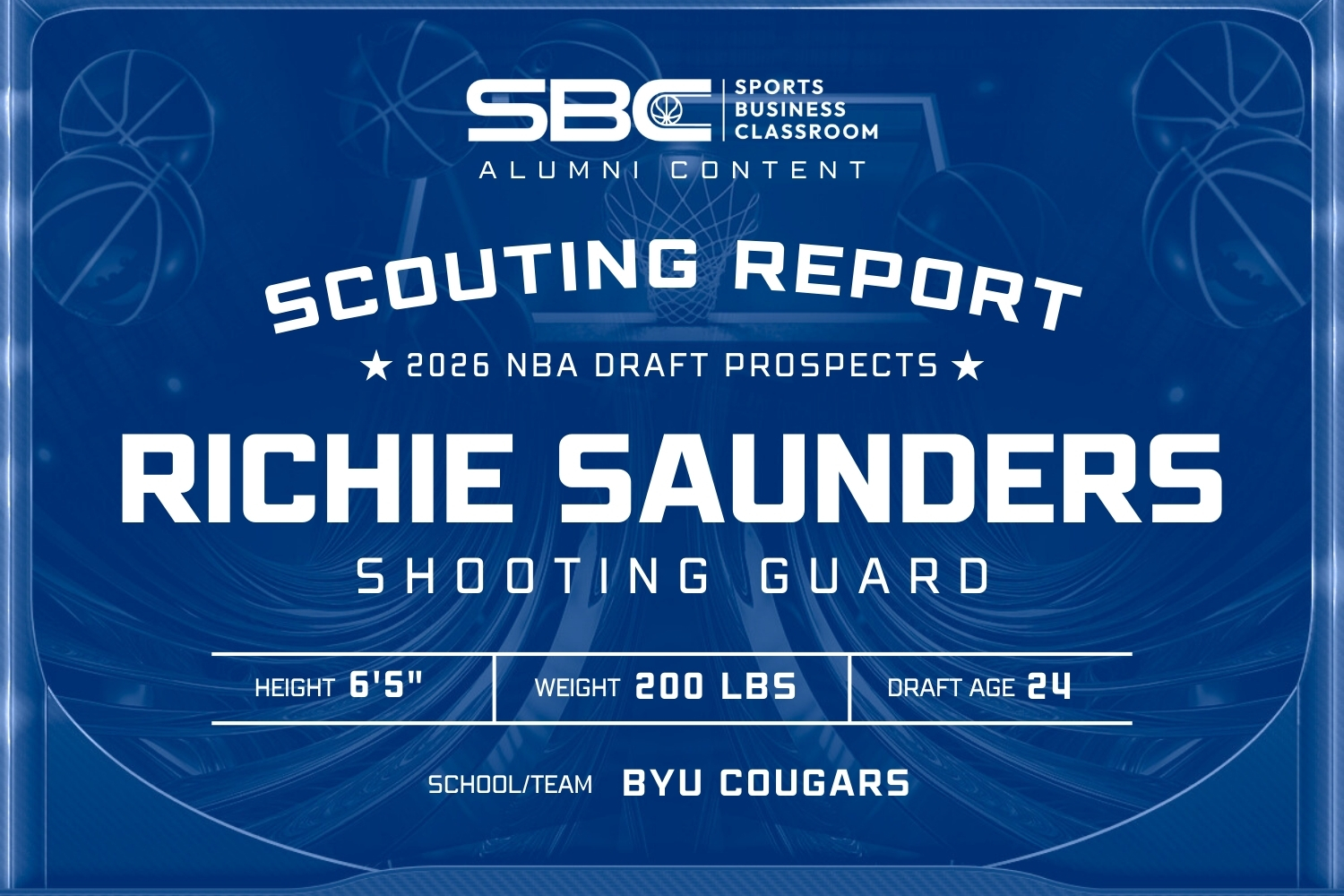
Richie Saunders
Frame: 6’5″, 200 lbs
Position: Guard
Team: BYU Cougars
2026 Draft Age: 24
Stats via sports-reference.com
Offense
Saunders has developed into one of college basketball’s most efficient scoring wings, thanks to a well-rounded offensive skillset and natural scoring instincts. Saunders transformed into the Cougars’ leading scorer in his junior year, averaging 16.5 points per game while shooting over 50 percent from the field and above 39 percent from three-point range, a rare combination in the competitive Big 12. He connected from deep in bunches, including multiple games with six three-pointers. He has had multiple games of hitting five or more three-pointers this season as well.
Saunders’ shot mechanics are compact and repeatable. He shows comfort both catching, shooting, as well as creating his own rhythm off movement and pump-fakes. He elevated his production further during the Cougars’ March Madness run last season, averaging 22 points per game over three games and ranking among the nation’s most efficient offensive performers in the tournament. The way Saunders releases at the apex of his motion makes his shot hard to defend.
Saunders has also developed attacking ability inside the arc off of pump fakes. He has a deceptive float game on pull-ups, a knack for finishing around the rim through contact when defenders overplay the three, and an emerging ability to read closeouts and punish mismatches. These traits make him a multi-level scorer. His free-throw accuracy and low turnover rate bolster his offensive reliability, as he makes the most of limited opportunities and minimizes wasted possessions.

Defense
Saunders’ defensive impact is rooted in intelligence, anticipation, and competitiveness, even if his physical tools don’t stand out. He has enough size to match most perimeter assignments, and his quick hands and active instincts frequently create turnovers and transition opportunities for the Cougars. He often brings energy that helps neutralize quicker guards, making him a reliable team defender in system rotations.
His court awareness and navigation of help-side responsibilities help him compensate for any shortcomings in pure lateral quickness. He understands defensive concepts, hedging appropriately off screens and helping contain ball-handlers until help arrives.
Still, his lack of elite athletic burst sometimes shows up when matched with quick or explosive guards. He can get caught on backdoor cuts or lose leverage against sudden direction changes. Because of this, he’s most effective within structured schemes where help defense and switches are coordinated.
Overall, Saunders isn’t widely recognized as a lockdown defender, but his competitive nature, steady defensive IQ, and physical play make him a positive contributor on that end. Those characteristics are particularly valuable in high-level college play and project well if he continues to refine his defensive fundamentals.
Looking Ahead
Saunders’ trajectory suggests he will continue ascending as both a leader and a strong offensive option for the Cougars. He committed to returning for his senior season, a decision that positions him to anchor the Cougars’ attack alongside incoming freshman talent, AJ Dybansta and transfer Rob Wright III. This should allow his team to make a deep postseason push. Being named to the Jerry West Shooting Guard of the Year preseason watch list underscores expectations that he will again be among the nation’s elite shooters and scoring guards.
Saunders can further expand his offensive repertoire beyond spot-up shooting into nuanced creation and midrange attacking, making him less dependent on spacing and more of a complete scorer. Improvement in his handle, decision-making under pressure, and ability to navigate screens could elevate his profile as a multi-phase offensive threat. Defensively, physical maturation and anticipation will be vital if he aims to contribute consistently at higher levels of play, particularly against premium athletes.
Saunders has garnered attention from national evaluators as an efficient shooting wing with a high basketball IQ and a track record of production in a major conference. Questions remain about how his game will translate to the NBA level, particularly in creation and defensive athleticism. Still, his shooting profile, scoring consistency, and steady improvement trajectory give him a clear pathway to being a valuable role player at the next level. The only other major worry organizations may have is Saunders’ age and development window. At 24, he is obviously closer to a finished product than a player who still will have opportunities to grow and develop new weapons. If he continues his upward climb and showcases expanded versatility this season, Saunders could be in line for meaningful conversations as a borderline late-first-round, early-second-round pick after this season concludes.