
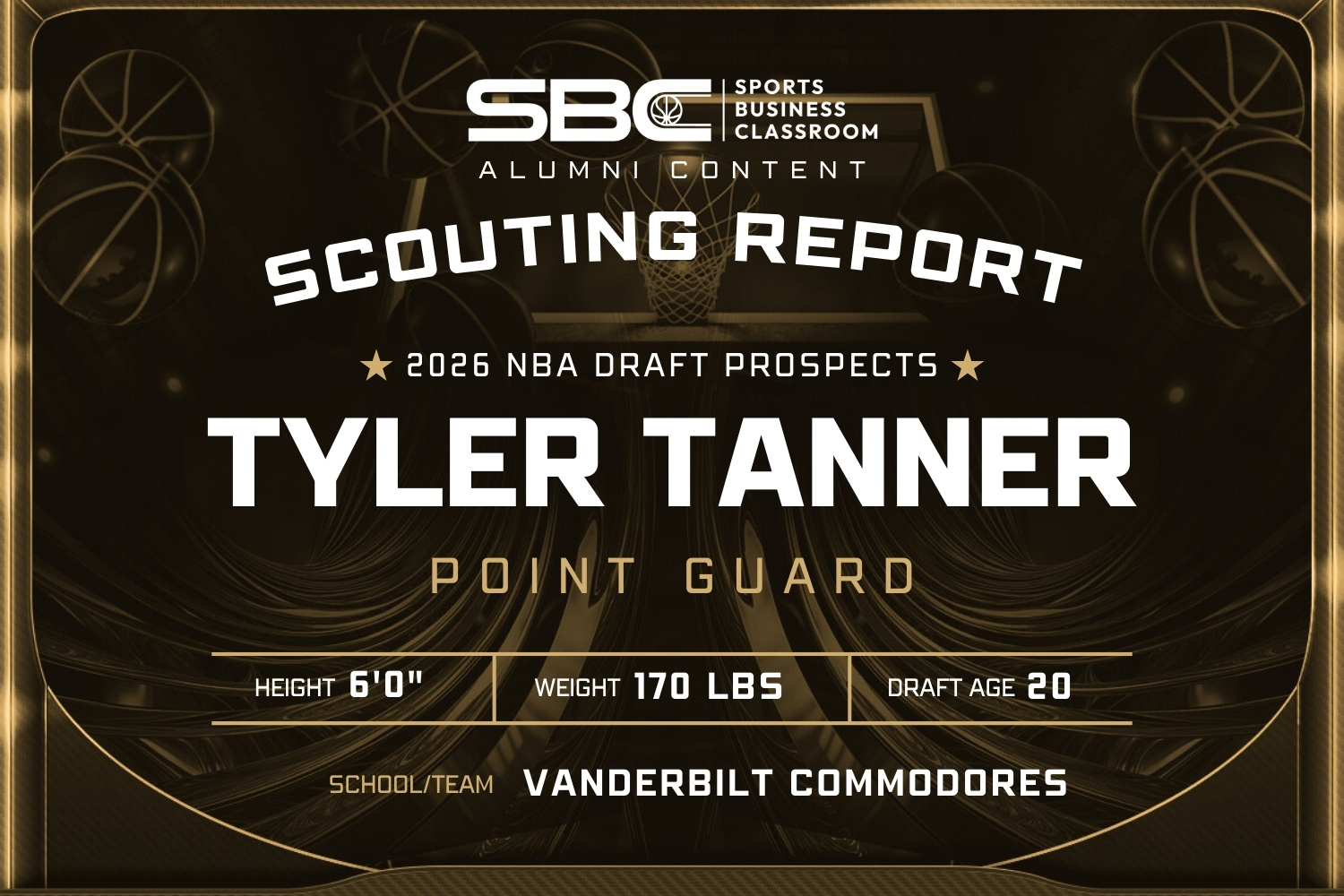
[The following scouting report is part of a series on potential 2026 draft prospects from Sports Business Classroom alumni.]
Tyler Tanner
Frame: 6’0”, 170 lbs
Position: Guard
Team: Vanderbilt Commodores
Draft Age: 20
Stats via: Sports-Reference
Offense
Tanner is a high-feel initiator whose offensive value is driven by advantage creation, efficiency, and decision-making rather than raw scoring volume. He consistently collapses defenses with downhill pressure, leveraging elite burst and change of pace to get into the paint. His processing speed shows up immediately once help commits. He delivers reads before windows fully materialize, reflected in a 29.8 assist percentage and an assist-to-turnover ratio north of 2.5 as the Commodores’ primary creator.
What separates Tanner from nearly every small-guard precedent is how his athleticism translates into real rim pressure. He finishes efficiently at the basket – converting over 60% of his half-court rim attempts – and has already recorded double-digit dunks this season, putting him on pace for close to 30 over a full year. No six-footer at this level has come close to his dunk rate since 2008, and the gap is not marginal. This is not cosmetic athleticism. It forces rotations, opens passing angles, and raises his foul-drawing rate above 35, a key driver of his offensive efficiency.
Tanner has taken a meaningful leap as a shooter, as well. He is converting roughly 39% from three on 7.9 attempts per 100 possessions while knocking down 87 percent of his free throws. Both are a massive improvement from his freshman year, signalling underlying touch. He is especially effective off the catch, clearing 40%, and remains viable off the ball as a mover and closeout attacker.
The swing skill remains pull-up shooting. Tanner is still under 31% on pull-up threes and has not yet developed a dependable in-between counter, which shows up in a sub-33 percent mark on runners and floaters. Continued growth in these areas will determine how aggressively NBA defenses can sit in drop coverage against him.

Defense
Tanner’s defensive profile is where he breaks historical precedent. He owns a steal rate near 5% and a block rate above 2 percent, an integration that is virtually nonexistent for guards his size. Tanner ranks first in block rate, second in steal rate, and near the top in true shooting among the 319 high-major players listed at 6’0” since 2008, a combination that does not appear elsewhere in the data.
The film supports the production. Tanner processes actions early, jumps passing lanes before reads are obvious, and rotates into contests with rare timing for a guard. His block numbers are not the result of gambling; they come from vertical timing as a help defender and anticipation as a low man. He has also emerged as one of the best pressing guards in college basketball, applying early pickup and forcing ball-handlers to initiate offense under duress. His burst and balance allow him to recover quickly, without constantly compromising the defensive shell behind him.
At the point of attack, Tanner plays with a low center of gravity, sharp lateral movement, and disciplined angles. He can stay attached through changes of direction and is comfortable navigating screens. The more relevant NBA concern is not isolation defense but rotational responsibility. Smaller guards are often exposed as low men and secondary helpers rather than on-ball defenders. This is where players like Jalen Brunson and Trae Young have been most damaging defensively. Tanner’s anticipation, vertical timing, and motor give him a better chance than most small guards to survive those assignments, but his frame remains a limiting factor. Added strength and scheme support will be critical.
Looking Ahead
Historically, guards under 6’0” face the steepest translation bar in the draft. Only 16 players below that threshold have been drafted since 2008, and very few have delivered sustained NBA value. He profiles as a guard who can scale up and down without losing impact.
Tanner’s profile does not resemble the typical small-guard bet. His production places him at the extreme end of every indicator that tends to translate: efficiency, ball security, defensive playmaking, and feel. He ranks first in dunks per game, first in block rate, top three in steal rate, top three in true shooting, and top 15 in assist-to-turnover ratio among players his height since 2008, all while scaling usage year over year.
Tanner projects as a lead guard who does not require heliocentric usage to impact winning. He can run offense, toggle off the ball, pressure the rim, generate extra possessions with steals, and avoid giving possessions back with turnovers. The Fred VanVleet comparison is instructive, particularly when accounting for Tanner’s age and superior athletic pop at the same stage. Tanner has a realistic path to being one of the rare undersized guards who hold up in high-leverage NBA environments.
This is not a bet against size. It is a bet that elite cognition, efficiency, and two-way disruption still outweigh archetype rigidity. Tanner’s profile suggests that, in his case, they do.