
The NCAA and other worldwide leagues are officially in full swing, and the NBA season is already at the first quarter mark. Scouts are now hard at work looking for their teams’ next potential star and core pieces. The following are scoring guards to watch ahead of June’s draft, as a part of Sports Business Classroom’s 2025 NBA Draft series.
A scoring guard is categorized as a backcourt player who possesses a score-first approach to their offense, as opposed to a lead guard who approaches it with a pass-first mindset. These guards score in various fashions, including with and without the ball, in the paint, beyond the arc, and more.

First Round:
- Darryn Peterson – Kansas
- Brayden Burries – Arizona
- Tounde Yessoufou – Baylor
- Cameron Carr – Baylor
- Meleek Thomas – Arkansas
- Dash Daniels – Melbourne United (Australia)
- Braylon Mullins – Connecticut
Second Round:
- Dame Sarr – Duke
- Solo Ball – Connecticut
- Ryan Conwell – Louisville
- Ian Jackson – St. John’s
- KJ Lewis – Georgetown
- Paul McNeil Jr. – North Carolina State
- Otega Oweh – Kentucky
- P.J. Haggerty – Kansas State
G League/Undrafted:
- Joson Sanon – St. John’s
- Oziyah Sellers – St. John’s
- Emanuel Sharp – Houston
- Chase Ross – Marquette
- Richie Saunders – BYU
- Fletcher Loyer – Purdue
- Billy Richmond – Arkansas
Darryn Peterson is far and away the top scoring-guard prospect in this draft class. He plays a very mature style. He lets the game come to him, knows where his spots are, how to get to them, and how to get buckets from them. This, combined with his patient approach and high-level footwork, makes for a very polished shot IQ and an extremely tantalizing offensive ceiling. Peterson will be in the mix for the first overall pick on draft night, along with Duke’s Cameron Boozer and BYU’s AJ Dybantsa.
He’s a level-headed player, not letting the flow of the game affect his emotions. He is not a jaw-dropping athlete, but what he lacks in elite athleticism and burst, he makes up for in patience and efficiency, emphasized by his 52.8/42.3/76.9 shooting splits through his first four collegiate games. He thrives in transition and in the half-court, and has an excellent feel for when and where to move the ball.
Peterson is an NBA-ready combo guard with a high floor that can provide stability and consistency to any backcourt. He has been dealing with a nagging hamstring injury, so don’t be surprised if he gets shut down early to ensure he is primed and ready to go for the 2026-27 NBA season.
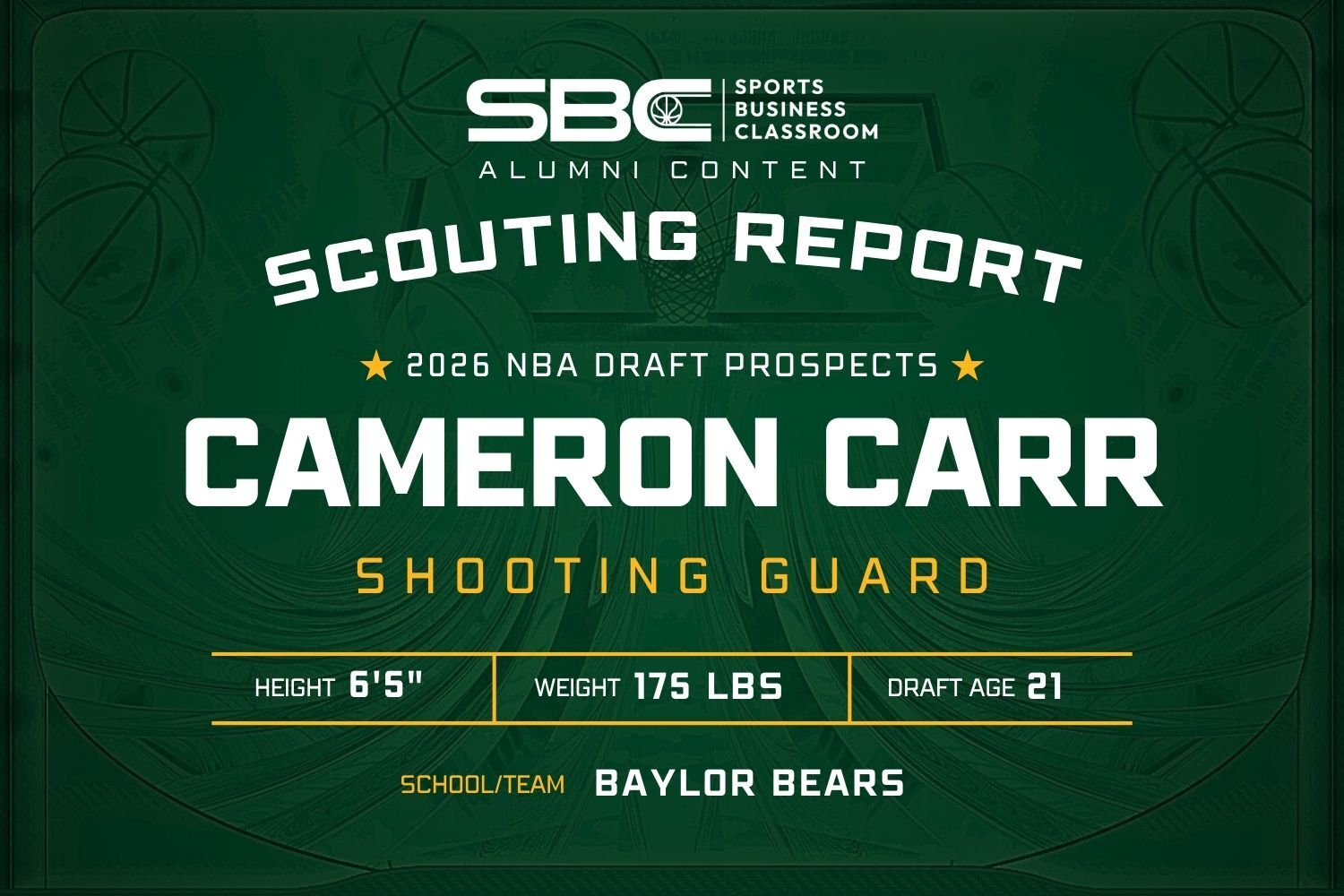
One of the biggest risers in college basketball this season has been Baylor Bears transfer Cameron Carr. Carr was unable to get a real opportunity to shine in his first two seasons with the Tennessee Volunteers. Following a redshirt sophomore season, however, he has burst onto the scene with the Bears, amassing 21.4 points and 5.6 rebounds per game on 55.1/42.6/79.6 splits. The 6’5” sophomore can score at every level in impressive fashion.
Carr was initially timid and shy with the Volunteers, but has come out of his shell this year. He’s shown off extreme vertical athleticism and shot-making prowess, to go along with a smooth jumper. His confidence with the Bears is now meshing with the discipline he learned in his more timid years with the Volunteers. Carr can score off the dribble, but seldom will he force up a shot he doesn’t feel he can make. Instead, he will dish the ball and change his focus on relocating to try and find a way to get open.
This discipline applies on the defensive end as well. Carr does an excellent job as a help defender at the rim without fouling, averaging 1.7 blocks per game and only 2.0 fouls. Carr needs a greater sample size to prove to NBA teams that he’s here to stay. If he can, he’ll be well on his way to a first-round selection.
Dame Sarr is one of the most raw offensive talents heading into the 2026 NBA Draft. The 19-year-old took his talents to the NCAA to join a loaded Duke Blue Devils team after spending some of his teenage years at FC Barcelona. He started his first eight games of the season before being replaced by fellow NBA draft hopeful Nikolas Khamenia.
Sarr has elite defensive potential. He has been a consistent and effective ball stopper – with a 6-foot-8, 190-lb frame, and 7-foot wingspan – for this Blue Devils team, which ranks as one of the best defensive teams in the country. His elite anticipation in both the passing lanes and when defending in isolation is why he is ranked top-five in steal percentage in the Atlantic Coast Conference and will keep his name among the late-first/early-second round talks heading into June.
He has a lot of room for growth on the offensive end. He shows potential to be a strong shooter, shooting 44.8% with Barcelona in 2024-25, but this was on 1.4 attempts per game. He has increased his volume, but his efficiency has dropped to 35.3%. Sarr will need to rely on a consistent jumpshot to earn a spot in an NBA rotation without elite burst, ball creation, or vertical athleticism.
Ryan Conwell is in his fourth and final stop with the Louisville Cardinals this season and has been one of the best scorers in the nation. The left-hander’s game involves a high dosage of triples at a highly efficient clip, shooting over 40% over the last three seasons on a staggering 7.7 attempts per game. Conwell is also a fearless attacker, shooting 6.0 free throws per game thus far this season. Conwell is a great secondary playmaker, recording 2.5 assists per game over his last three seasons and only 1.7 turnovers.
He has also continued to challenge himself not only in a new setting but also in a new conference, switching teams for each of his four college seasons. He has found himself in a more challenging conference (Missouri Valley Conference to Big East to ACC) and has continued to improve. This should provide NBA teams with added confidence that he is well prepared for the upgraded competition in the NBA.
Joson Sanon has flown under the radar of many over the past two seasons. Sanon averaged 11.9 points and 3.4 rebounds on good efficiency in his freshman season with the Arizona State Sun Devils. Sanon then joined a stacked St. John’s Red Storm team for his sophomore season. Sanon has been a staple in Coach Rick Pitino’s starting lineup. He’s big at 6-foot-5, 200 lb, and has been a reliable three-point shooter this season at 43.2%.
His youth and shooting may at least put him in the second round. However, Sanon’s inside scoring and defensive consistency raise many questions. He has only shot 37.2% from inside the arc so far this season, including a not-so-impressive 42.3% at the rim.
There are aspects of his game that cannot necessarily be taught, like his lack of athleticism, but he has the physical tools and range to be a three-level scoring threat one day. He likely won’t be up for a spot in the draft this time around, but if he decides to declare and leave behind his collegiate career, a team could find a young gem to stash in the G League and grow to their vision.