
[The following scouting report is part of a series on potential 2026 draft prospects from Sports Business Class alumni.]
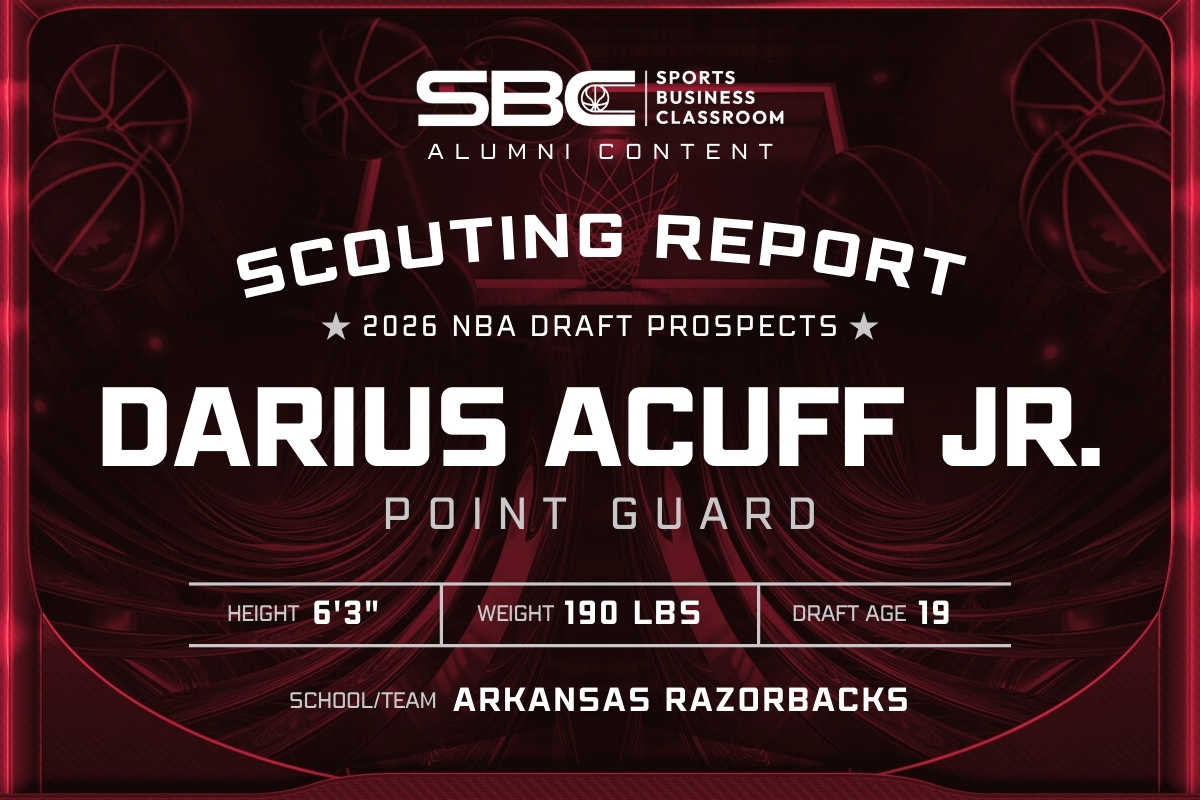
Darius Acuff Jr.
Frame: 6’3″, 190 lbs
Position: Point Guard
Team: Arkansas Razorbacks
2026 Draft Age: 19
Stats via sports-reference.com
Offense
Acuff is an advanced three-level scoring guard whose game is built on a blend of poised decision-making, craft, and natural scoring instincts. He plays with a calm, deliberate pace and is rarely sped up by pressure. He shows an intuitive ability to manipulate defenders. His handle allows him to create separation without relying on elite burst; instead, he uses timing, hesitation, and change of pace to dictate the flow of the possession. He’s especially effective using ball screens, where he strings out defenders and patiently waits for coverages to reveal openings. His pocket passes and live-dribble feeds demonstrate early signs of advanced pick-and-roll feel.
Acuff is very comfortable handling the ball, creating for himself off the dribble, and taking and making catch-and-shoot opportunities. He may not be the lead isolation scorer in every possession, but his ability to read defenses — off-ball and on the move — gives him a versatile offensive role.
He can finish at the rim and pull up in the midrange, as well. Acuff uses his less-than-dominant frame effectively to absorb contact and finish in traffic. His court vision and decision-making are beyond what many freshmen guards display, and he has shown the capacity to make next-level reads.
One of his standout offensive traits is his shooting. He is knocking down three-pointers at a very efficient rate. That shooting, combined with his feel for spacing, allows him to find open looks even in congested defenses. His mechanics are compact and repeatable, and he has shown comfort both stepping into rhythm threes and hitting off dribble pull-ups. What elevates his shooting profile is his shot selection. Acuff rarely forces contested threes early in the clock, and instead understands when to attack downhill, when to pull up, and when to move the ball. His early efficiency from deep appears sustainable because it is rooted in discipline, balance, and well-timed relocation.

Defense
Acuff shows promise defensively, but also areas where he can grow. He is engaged and has a high motor. Acuff actively communicates to his teammates if he is not the focal point of a designed play or being picked on by the offense. He positions himself well defensively. He isn’t the most explosive athlete, which can limit his ability to recover in certain matchups. Still, his basketball IQ helps him compensate: he often understands where to be, when to hedge, and when to contest.
He understands team-defense principles: tagging rollers, sinking to the nail when needed, showing early help, and recovering while being under control on a closeout. His anticipation is evident in his ability to jump passing lanes or stunt at drivers without completely losing accountability for his assignment.
Acuff competes on the ball. His stance is solid and strong. He has enough strength in his lower body to absorb bumps from opposing guards trying to get downhill. His positional awareness and timing allow him to stay attached and contest shots effectively without elite lateral twitch. He guards with purpose, sliding early to cut off drives rather than reacting late, and he keeps his hands active without being overly reach-oriented or getting into foul trouble.
He doesn’t ball-watch excessively when off-ball, and he maintains an understanding of personnel and responsibilities. His help-side rotations have been timely, and he takes correct angles, doesn’t over-commit, and is quick to recover to shooters. He could become a reliable team defender with above-average instincts for the point guard position should he add some strength.
He has some potential to guard both smaller, quicker guards as well as somewhat bigger lead guards. His frame helps with physicality, but to be fully effective at higher levels, he will likely need to continue building strength and improve his lateral quickness.
Where he will need continued development is in handling elite quickness. Faster, more explosive SEC guards can force him into recovery mode if he doesn’t anticipate the first step. Improving his slide efficiency, first-defensive step, and overall lateral burst will help him handle matchups against high-quality opponents. His ability to fight through ball screens should improve with added strength. At the moment, he relies on angles rather than force, and as the competition becomes more physical, that technique will need to be adjusted.
Looking Ahead
Acuff’s projection is very compelling: in the short term, he looks like a foundational piece for Arkansas’ backcourt. His combination of scoring, playmaking, and leadership makes him a go-to guard in Coach John Calipari’s system. He’s not just a scorer — he’s a play initiator, which gives Arkansas flexibility in its offense.
Over the longer term, Acuff shows first-round potential. If he continues to develop his shot, tighten his decision-making, and improve defensively, he will be a highly-regarded prospect who will climb up draft boards. His pedigree, maturity, and early success suggest he may not need many years in college before making the jump, and could follow in a long line of one-and-dones who have been through Coach Calipari’s development.