
Kingston Flemings
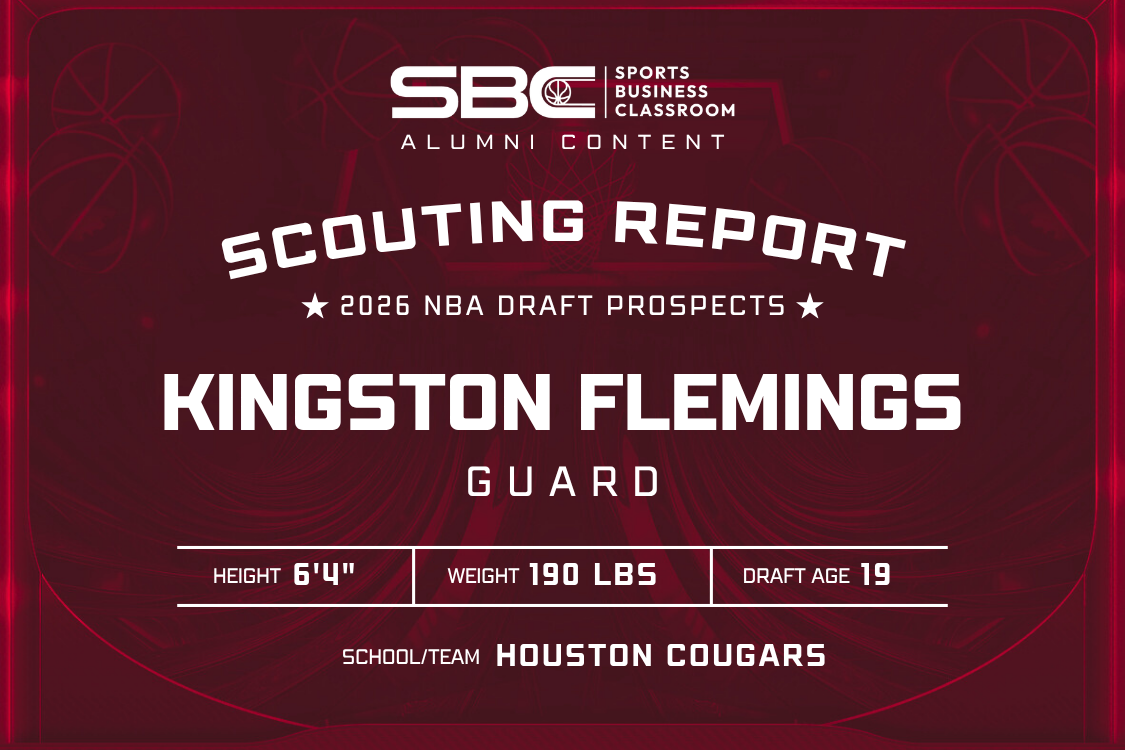
Frame: 6’4″, 190 lbs
Position: Guard
Team: Houston Cougars
2026 Draft Age: 19
Stats via https://www.sports-reference.com/cbb/players/kingston-flemings-1.html
Offense
Kingston Flemings projects as a modern lead guard whose game is built around pace manipulation, rim pressure, decision-making, and efficient shot creation. While Houston’s system traditionally emphasizes physicality and defensive accountability, Flemings quickly established himself as one of the offense’s primary engines due to his ability to consistently create advantages with the ball in his hands. Scouts are particularly intrigued by the combination of his burst, change-of-direction ability, and advanced feel as a pick-and-roll operator. Multiple draft evaluations have highlighted his ability to function as a high-usage creator while maintaining strong efficiency and low turnover numbers for a freshman lead guard.
Flemings excels at generating paint touches. His first step is explosive, but what separates him from many young guards is his ability to change speeds and keep defenders on there heels. Rather than relying solely on raw athleticism, he manipulates help defenders, snakes ball screens, and creates driving angles that allow him to reach the rim consistently. He demonstrates excellent body control when finishing through traffic and shows comfort using extension finishes, floaters, and touch shots to compensate for size disadvantages against longer defenders.
As a passer, Flemings displays true lead-guard instincts. He consistently identifies weak-side rotations and delivers accurate skip passes to shooters. His ability to process multiple defensive actions while attacking downhill gives him significant offensive value beyond his scoring. Houston trusted him to orchestrate offense in high-leverage moments because of his composure and decision-making, traits that are uncommon among freshman guards. Draft observers and evaluators have repeatedly cited his basketball IQ and passing vision as major strengths.
His jump shot has improved substantially and is trending toward becoming a legitimate weapon. Flemings shot effectively from three-point range during his freshman season at Houston and appears comfortable both as a catch-and-shoot threat and as a creator off the dribble. His shooting mechanics are compact and repeatable, though there are still stretches where he defaults to mid-range pull-ups rather than consistently hunting efficient three-point attempts. Increasing his three-point volume could unlock another level of offensive value at the NBA level.
The primary offensive concerns center on his physical projection. While he was an excellent college finisher, some scouts question how easily he will generate the same quality of rim opportunities against NBA athletes and length. He is not an overwhelming physical presence and occasionally relies on craft rather than power to complete possessions. Continued development of his pull-up shooting and floater package will be critical as he transitions toward professional competition.
Defense
Flemings’ defensive profile is one of the major reasons NBA teams view him as a relatively safe prospect. Houston’s culture demands discipline, effort, and toughness, and Flemings embraced those responsibilities immediately. His point-of-attack defense stands out because of his ability to contain penetration and stay attached through screens. He plays with a level of competitiveness that often sets the tone for teammates around him.
His lateral quickness allows him to mirror opposing ball handlers, while his anticipation creates opportunities for steals and disrupted offensive actions. He understands positioning, rotates on time, and consistently competes through multiple efforts within a possession. Unlike many young offensive-minded guards, Flemings demonstrates an understanding of team defensive concepts that should help him earn minutes early at the next level.
One of the most translatable aspects of Flemings’ defensive game is his ability to create turnovers without sacrificing structure. Many young guards generate steals by gambling out of position, but Flemings typically operates within the framework of the defense. He understands when to apply pressure, when to shade ball handlers toward help, and when to attack passing lanes. His steal production is driven as much by anticipation and timing as it is by athleticism, which is encouraging for his long-term NBA projection because those instincts tend to translate across levels. His defensive playmaking is one of the strongest indicators of future two-way value as well.
Away from the ball, Flemings displays the type of awareness teams look for in guards expected to contribute to winning basketball. He frequently operates like a defensive “free safety,” reading offensive actions before they fully develop and positioning himself to disrupt them. Whether it is tagging a roller, digging down on a post-up, or rotating into passing lanes from the weak side, he demonstrates a strong understanding of team defensive concepts. His ability to process offensive actions quickly often allows him to arrive at help positions before opponents anticipate his presence.
Another underrated component of his profile is how well he recovers after being beaten initially. Flemings possesses excellent short-area burst and body control, which allow him to re-engage in possessions that appear lost. Even when offensive players gain a step, he frequently stays attached enough to contest from behind, force difficult angles, or influence finishing attempts at the rim. This recovery ability should help him remain viable against NBA athletes who are capable of creating separation against virtually any defender.
The biggest defensive question involves physical measurements. While he competes at a high level, he is not an oversized guard and lacks the exceptional length possessed by some of the elite defensive guard prospects. Bigger NBA creators could target him in switches, and stronger guards may challenge him physically until he adds more strength. Those concerns are more about ceiling than floor, however, because the effort level and defensive instincts are already NBA-caliber.
What ultimately elevates Flemings above many guard prospects is the combination of defensive floor and defensive ceiling. He already projects as a player who can survive within sophisticated defensive schemes because of his instincts, competitiveness, and processing speed. If he continues to add functional strength and refines his screen navigation, there is a realistic pathway toward becoming one of the better defensive guards in the league. His ability to impact possessions both on and off the ball gives him considerably more defensive versatility than the average lead guard prospect entering the NBA.
Looking Ahead
Flemings projects as a starting-caliber NBA point guard with legitimate two-way upside. His combination of rim pressure, playmaking, shooting development, and defensive competitiveness makes him one of the more complete guard prospects in his class. Evaluators frequently compare aspects of his game to dynamic downhill guards such as De’Aaron Fox and Tyrese Maxey because of his speed, attacking mentality, and ability to pressure defenses.
The pathway toward becoming a high-end NBA starter is relatively straightforward. Continued growth as a pull-up shooter, greater comfort finishing through elite size, and additional physical strength could elevate him from a reliable starting guard into a potential All-Star level creator. Even if those improvements come gradually, his floor appears relatively high due to his decision-making, defensive commitment, and overall feel for the game.