
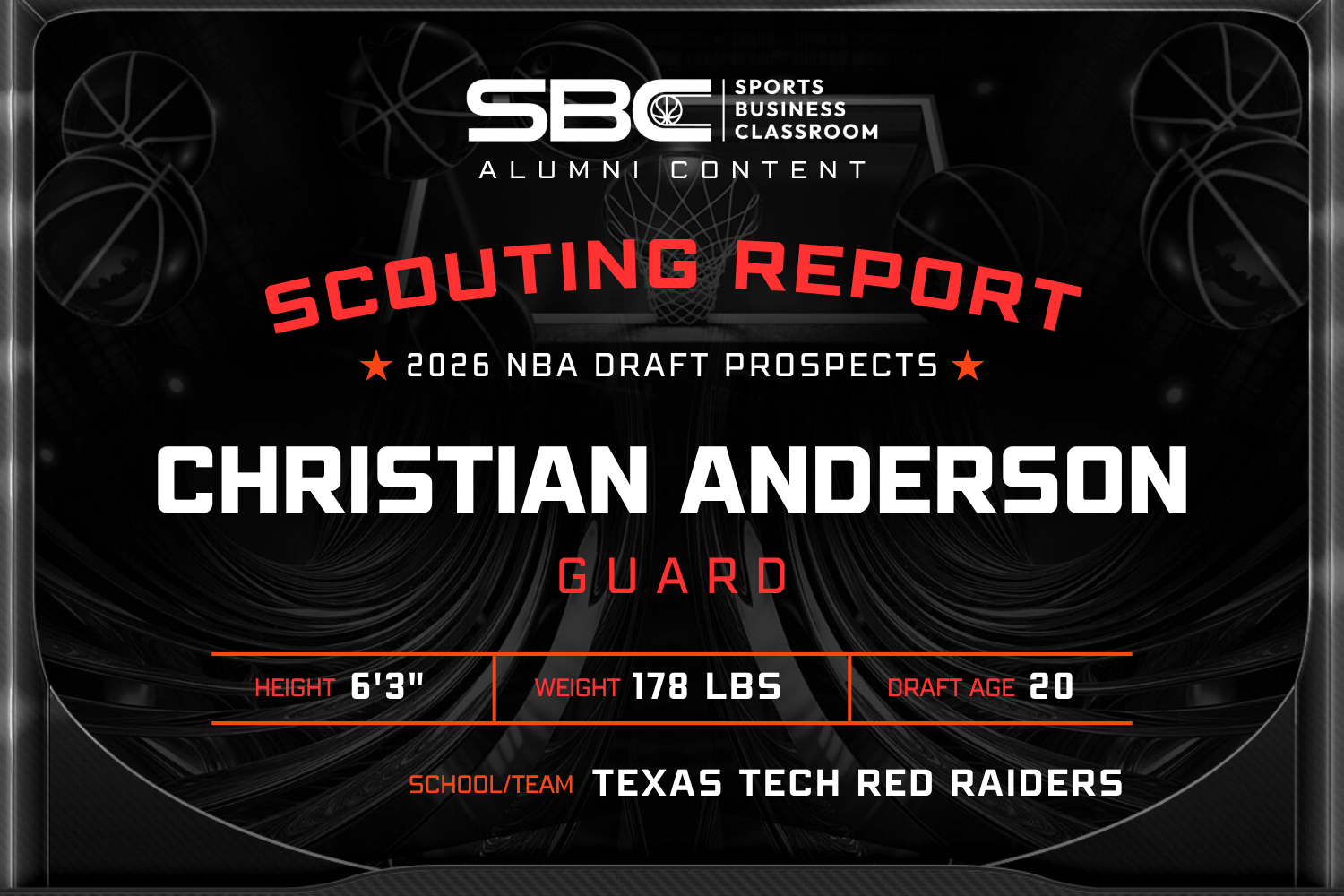
Christian Anderson
Frame: 6’3″, 178 lbs
Position: Guard
Team: Texas Tech Red Raiders
2026 Draft Age: 20
Stats via https://www.sports-reference.com/cbb/players/christian-anderson-2.html
Offense
Christian Anderson is one of the most polished offensive guards in college basketball and profiles as a highly skilled shot creator capable of operating both on and off the ball. His offensive game revolves around perimeter shooting, advanced pick-and-roll reads, and a mature understanding of spacing. While many young guards rely heavily on athletic advantages, Anderson wins through skill, timing, and offensive IQ. Community evaluations and draft discussions consistently point toward his combination of shooting and playmaking as his defining strengths.
As a shooter, Anderson possesses genuine NBA range. He is comfortable firing off movement, relocating after passes, and creating separation with step-backs and side-step jumpers. His quick release makes him dangerous in both catch-and-shoot and pull-up situations. Defenders are forced to extend pressure far beyond the three-point line, which opens driving lanes and creates opportunities for him to manipulate defensive coverages.
Anderson’s growth as a primary facilitator significantly elevated his profile. He has developed into a reliable pick-and-roll creator who routinely identifies weak-side help and delivers accurate passes to shooters and rollers. His passing isn’t flashy for the sake of creativity; rather, it is efficient and purposeful. He consistently makes the correct read and keeps offenses flowing. The jump in his assist production demonstrated a greater command of offensive responsibilities and highlighted his ability to function as a lead initiator.
One area where Anderson faces challenges is interior scoring. He is not an explosive vertical athlete, and much of his offense originates from skill rather than overwhelming physical tools. Against longer defenders, he can struggle to generate clean finishing angles near the basket. As a result, he often relies on floaters, pull-up jumpers, and touch shots rather than consistently attacking all the way to the rim.
At the NBA level, his offensive value will likely be tied to how effectively he balances scoring and playmaking while maintaining efficiency against superior athleticism. Fortunately, his shooting versatility gives him a pathway to impact games even when he isn’t serving as the primary ball handler.
Defense
Defense remains the biggest question mark in Anderson’s evaluation. While he competes and understands his teams concepts, his physical profile creates concerns when projecting him against NBA guards. He lacks elite size and does not possess exceptional vertical explosiveness, which limits his margin for error on the defensive end.
Against college competition, Anderson generally survived through positioning and anticipation. He understood where to be within defensive schemes and worked hard to avoid mistakes. However, when isolated against highly athletic guards, he struggled to contain dribble penetration. NBA teams will undoubtedly test his ability to navigate switches and defend larger creators.
One of Anderson’s more intriguing defensive traits is his ability to compensate for physical disadvantages with anticipation. He is an advanced processor on the defensive end, often recognizing offensive actions before they fully develop. Rather than simply reacting to screens, cuts, and dribble handoffs, he frequently appears to be diagnosing the next action in real time. This allows him to beat opponents to spots and maintain defensive positioning despite lacking elite size or explosiveness. For a guard whose physical tools will always be scrutinized, that level of anticipation becomes a critical part of his defensive survival kit.
Anderson also displays a level of competitiveness that translates particularly well to modern NBA schemes emphasizing multiple efforts. He rarely concedes possessions after an initial breakdown. Whether recovering back into a play, rotating to contest an open shooter, or scrambling after a defensive switch, he consistently remains engaged. Coaches place significant value on guards who continue executing assignments after the first action fails, and Anderson’s willingness to make secondary and tertiary defensive efforts helps offset some of his physical shortcomings.
The encouraging aspect of his defensive projection is that intelligence and effort are already present. He rarely appears lost within team concepts and generally executes assignments correctly. If he continues adding strength and improving lateral mobility, he can become a serviceable defender rather than a player who must be hidden schematically.
Ultimately, Anderson’s defensive projection is a study in balancing instincts against physical limitations. The size concerns are real and will likely prevent him from ever becoming a true defensive stopper. At the same time, his awareness, effort level, screen navigation, conditioning, and competitive makeup give him a pathway toward becoming a functional NBA team defender. The most realistic outcome is not a guard who consistently wins possessions through overwhelming physical tools, but one who succeeds through positioning, intelligence, and relentless effort. Those qualities often determine which undersized guards remain on the floor during playoff basketball and which become matchup-dependent options.
Looking Ahead
Anderson’s NBA projection centers around elite offensive skill development. His shooting, decision-making, and ability to organize offense give him a realistic pathway toward becoming a high-level rotational guard and potential starting point guard. If the shot continues translating against professional defenses, he could carve out a role similar to several successful smaller NBA guards who thrive through skill and offensive efficiency rather than physical dominance.
His ceiling will ultimately be determined by whether he can become an average defender and maintain offensive creation efficiency against superior athletes. Even if he does not develop into a high-level defender, his shooting and playmaking foundation provides a strong chance of long-term NBA value.